

Femininity and Folkcraft
Or; String and its Consequences...

This article is a sort-of follow up to my Women and Heathenry article! In that article, I give the context about gender roles that I will be talking about in this article.
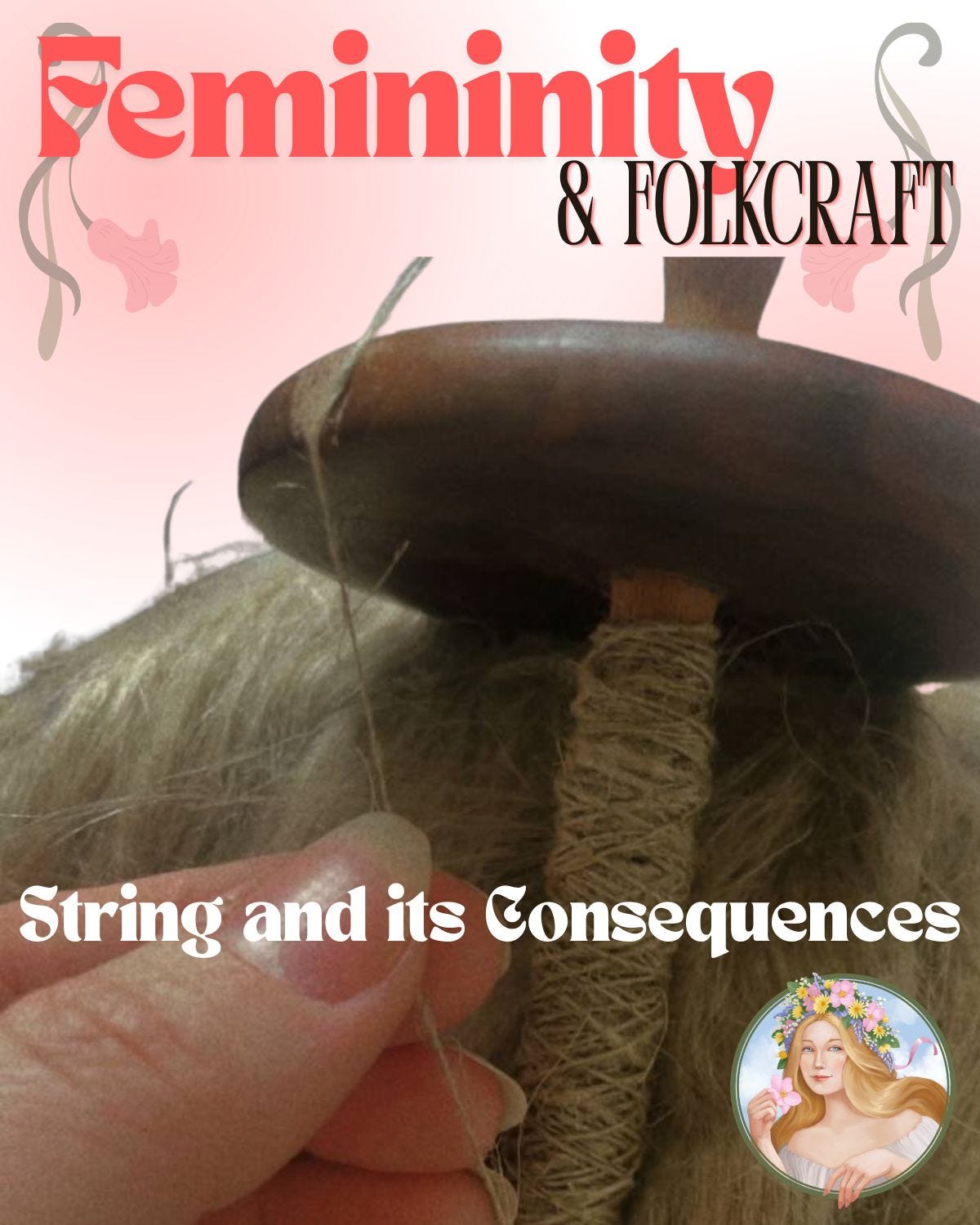
The most influential invention of all time is string. Fight me in the comments if you feel like you have to, but string has been the key to civilization long before the wheel, or formalized arithmetic, or the printing press. If you want clothing and textiles, you need string. If you want to bind a whole lot of things together to carry them from one place to another, you need string. If you want to weave sails that will take your ship to the next place you want to conquer, you need a lot of string. String is, as far as I am concerned, the key to civilization. This is part of the reason why so much emphasis in ancient times was put upon spinning, weaving, embroidering, knitting, sewing, and all other manner of distinctly feminine trades. The weavers of our Fate, whom even the Gods have little sway over, are three women in the fibrecrafts trade. Frigg is known as a legendary spinneress herself, often depicted with a drop spindle.
Women and string go hand in hand. Particularly in the European folk tradition, the creation, management, and use of string is more important than almost any other trade, secondary to maybe only food production (and still yet you can find plentiful uses for string in this, too). Caring about the tradition of our people means de facto recognizing the importance and leadership of women in these spheres.
Today, I want to talk about the areas of traditional society that very much should be led by women, and need women’s influence to thrive.
There is entirely too much talk about gender roles in the modern day. As I started to uncover in my Women and Heathenry article, the modern push for most people has been an intense androgenizing effect, and in short, I think a lot of traditionally-minded people, while mostly well intentioned, have swung way too far in the other direction, often mimicking the Victorian ideal of gender rather than an actually traditional, helpful, or useful ideal instead. I do tire of being told what should be done with the entirety of womankind. Particularly by tradlarping men who are barely concealing their clenched-jaw hatred of me, and especially by the league of harpy orbiters they employ against well-meaning women to try and convince us that this 19th century malarkey is the key to saving the West1.
This all being said, a truly benevolent patriarchy is okay with me. I do not desire to girlboss, nor to 4b, nor to hate men for the sake of. I have a great relationship with my father, and I love my husband very dearly, and most feminists do not like me very much after getting to know me, either. So, as in all things, balance is the key. However, something needs to be said about female leadership. I believe strongly in the fact that there are certain spheres2 where women should be leaders. And not, by the way, in the insipid way that online tradwives ensure me is ‘true leadership’; rather, real leadership.
So, let’s start there: Women should be in charge of women’s spaces. Honestly you could end the article there. It is an inescapable, historical fact, that women in (European) history have always worked, have always worked physical jobs3, have always worked outside of the home and for money, etc, ad infinitum. Now, what is not traditional whatsoever is the modern love of the desk jockey, nor the horrific (lack of) work-life balance that all people, but especially women, with respect to our biology, are expected to perform under. It is also not traditional whatsoever to expect a woman to work in the same manner that a man does. I will give you that. But in areas where women’s general thought patterns excel, and in traditionally feminine spheres, it is most natural (and therefore most traditional, I am arguing), to let women do the leading.
Feminine spheres
Women have been in charge of fibre production for thousands of years, particularly in Europe. In the few examples I was able to find of European societies where men took the lead on fibre production and use, it was almost 100% in fishing villages where men were living to work with no women present. In which case, fine, enjoy your darning, gentlemen.
I don’t bring up the fibre arts for superfluous reasons. Yes, it is easy to look on granny and her quilting as a sort of quaint pass-time, and I think a lot of people in the modern day4 tend this way. My reason for looping this all back on string and the world of fibre art is something I stated in the introduction: If you want to conquer the globe, you need very skilled spinners and weavers to like you enough that they will spend months making you a sail for your boat. If you want to spread your material culture, you need very skilled spinners, weavers, embroiderers, and lacemakers to produce things worth spreading. We do a lot of jaw-wagging in these circles about beauty being virtuous. And sure, not all beauty is necessarily to do with folkcrafts like fibre art (and I am getting there, trust me), but if this is a dearly held belief of ours, then we ought to respect the women who do these things.
It is for this reason that I believe any traditionally-minded fibrecrafter’s guild should be led and managed by women. I am primarily a fibrecrafter, but I feel the same way about jewellery making, and any sort of seamstress5 work, and most of the… call them domestic beautification tasks. Women have led these spheres for centuries and it is important to turn that job back over to them in the traditional mindset. And this is not superfluous, either. Material cultures are what survive into the coming ages. The extant clothing we have from ancient Europe was almost undoubtedly created and thoughtfully buried by women.
Now, I do have an inclination that the male-led weaver’s guilds will be brought up at some point. Let me just be clear: I don’t count it as a role reversal if women were specifically prevented from joining. If that’s your gotcha then try again. I also don’t much care for the gender role re-division that took place after Christianity was instituted, since that is not our tradition.
Throughout all of pre-Christian, Germanic society, women led the world of textile production. And they led it extremely well, because quality textiles were extremely economically significant— Kings could expect to finance their wars through taxes on the production and purchase of cloth, for example. This huge economic pillar (again, specifically leaving out the male-only weavers guilds for reasons aforementioned) was driven by women.
Of course, if your view is that women traditionally doing something makes it therefore lesser, like a lot of feminists and manosphere guys6 think, then sure, this will not mean much for you. “They did it out of a sense of duty to the society they lived in” the same way men worked fields, sheared sheep, and broke and scutched flax for linen. This was all out of a sense of duty to the society they lived in, because European society in general was more duty driven in our days of yore. This changes nothing about my fundamental argument.
Non-folkcraft beauty
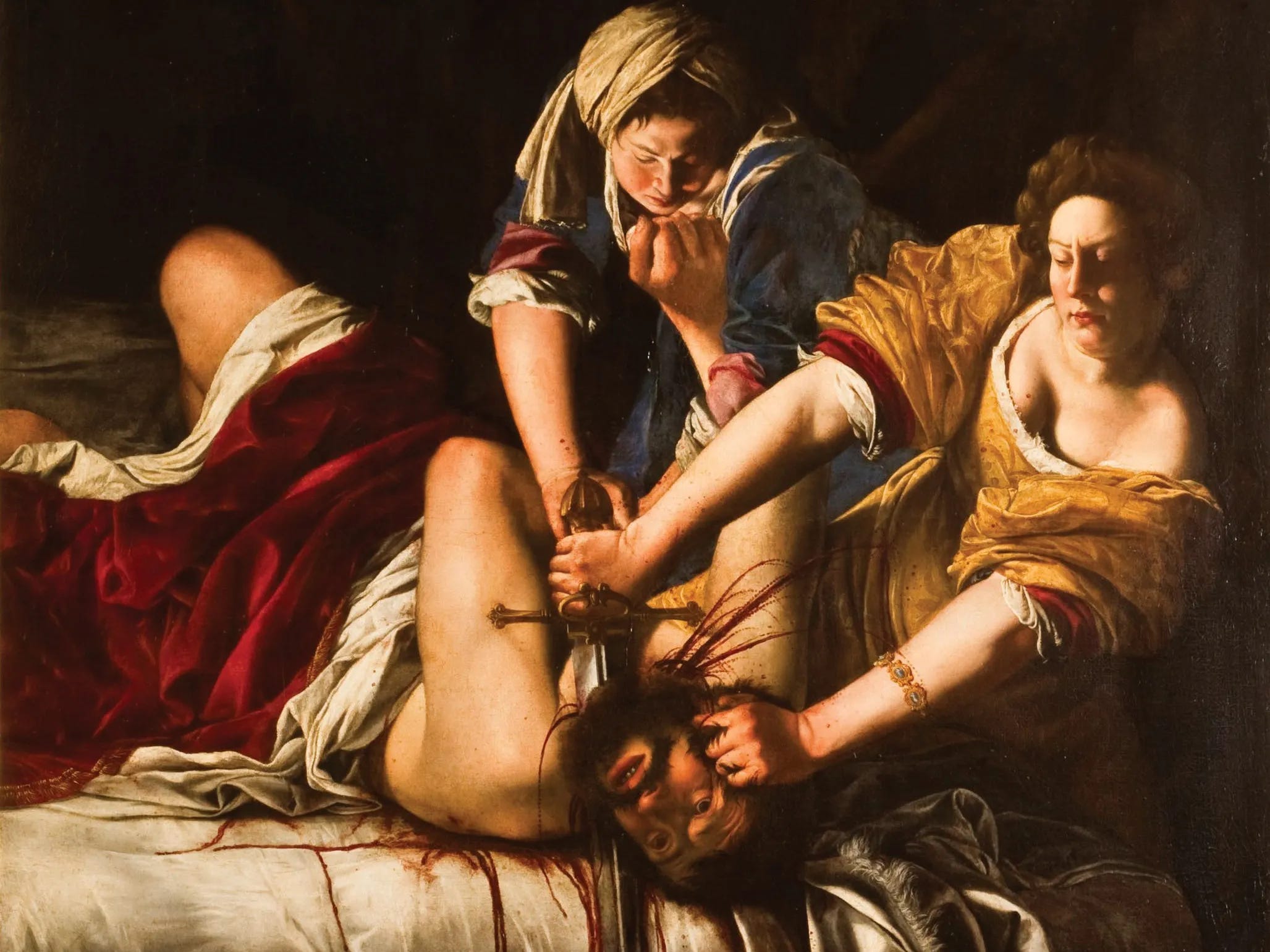
I need to take a brief detour, because not all beautification is folkcraft, and even though much of folkcraft is female dominated, one ‘societal beautification’ role that was traditionally not filled by women is the fine arts. Your frescoes, oil portraits, sculptures, and theatre performances (including, we think, most of those of a skaldic nature) were, famously, male dominated. This fact remained into the 19th century. And you know what, this distinction is very important. The male versus female take on art and The Arts™ should be noted going forward into the folk future, if we care about gender roles. That’s not to say we should formally bar legitimately talented people from creating what they please, but that in a gendered society, we should be recognizing the exceptions among the generalities.
(One such exception, by the way, is Artemisia Genileschi, who is the artist behind one of my favourite paintings of all time:)
This is in and of itself worth considering from a modern technological perspective. Women’s traditional work was replaced when machines took over for us— industrial weaving, knitting, and sewing is increasingly shunted to the third world, because it is simply too expensive to make “here”. Until the rise of generative AI, the fine arts masters had nothing to worry about in this regard; machines cannot make art, they were assured. If you were asking me for predictions, I would probably say we’re about to see some real panic (and in some senses we already are), now that the entirety of arts and material culture production can be handed over to a computer. What happens next is truly anyone’s guess, but I am willing to bet that, taking this into consideration, along with the fact that it’s hitting the traditional arts of both sexes, we will start to see major pushback.
The dire importance of ‘women’s work’
I once genuinely tried my hand at being an internet ‘tradwife’. It was a long time ago, before the 2022 explosion of the tradwives, and I enjoyed reading/watching what a lot of my fellow creators were doing with their time! One thing that did not fail to get under my skin was this radical (and entirely, obnoxiously modern) idea that so-called women’s work was lesser than that of a man. Of course, in a society driven by profit and ‘the grind’, everyone is expected to think this way. It’s part of the reason women were ‘invited’ into the workforce as second wave feminism started ramping up its intensity7.
I disagree with all of that. It’s somewhat vexing to me that so-called ‘trad’ anybody doesn’t disagree as well. The amount of traditionally minded men, or so they say, who sort of scoff at women’s work, is frankly enraging. And it reflects poorly on their understanding of what a folk-first society would actually look like, too. However, male push-back is somewhat expected, the reactionary take to anything positive regarding women is usually to blame feminism and keep it trucking. The far more vexatious push-back is from women. Trad and ultra-modern alike, you cannot escape women telling you with a sneer that ‘women’s work’ is just, unimportant stuff that women do to be subservient in their own households. The faux-traditionalist take on the matter is the most insipid and exhausting one of all, as if ‘living the slow life’ is some sort of quaint thing we do as an act of surrender, or something like that.
(If it’s tough to tell, this is all the dumbest shit I’ve ever heard.)
If you like having things like clean clothes, well cooked home meals, organized households (and not in a cleaning sense, I mean a well-managed household on a personnel level!), and yeah, a home that is beautiful and well maintained, then women’s work is probably pretty important to you as well, even if you’re scared of admitting it. I grow deeply weary of the miserable work-life balance we’ve invented which makes ‘home’ just the place you go when you’re done being at work for the day. It’s frankly disgusting. Home is the most important place. I believe CS Lewis’ quote about homemakers being the terminal occupation, upon which all other occupations find their raison d’etre, to be the most apt.
“I think I can understand that feeling about a housewife’s work being like that of Sisyphus (who was the stone rolling gentleman). But it is surely, in reality, the most important work in the world. What do ships, railways, mines, cars, government etc exist for except that people may be fed, warmed, and safe in their own homes? As Dr Johnson said, ‘To be happy at home is the end of all human endeavour’. (1st to be happy, to prepare for being happy in our own real Home hereafter: 2nd, in the meantime, to be happy in our houses.) We wage war in order to have peace, we work in order to have leisure, we produce food in order to eat it. So your job is the one for which all others exist.”
For those of us on the ‘tribal religion’ side of the equation, nothing should be more obvious to you than this. Healthy homes, happy families, and stable communities are kind of like, our thing, guys.
None of this needs to be seen as the preamble to some feminist about-face, either. The only thing I wish to comment on is the cultural significance of women’s work in a complementarian sense. Feminism presupposes, oddly enough, that the way to gain equality is to act like a man and leave behind the shackles of women’s work. I’m advocating for asking them what the hell they mean by ‘shackles’, and why we hate our historical contributions so damn much.
I do genuinely think it has something to do with that damn Axial Turn. The aforementioned article is highly worth considering, particularly when we’re thinking about the chronological evolution of gender roles and gendered work, from relatively complementarian to overtly, malignantly patriarchal (the goddamn Victorians, who I’m nearly always shaking my head at these days), to the very much Androgyne-hierarchy we’re seeing today. Think about how axiality, as Maxwell describes it, has introduced ‘the individual’, and then contrast that with what I’ve said about societies being highly more duty-bound until very recently. For me, the picture about gendered work division came very starkly into contrast while I was puzzling over this.
In short, we’ve devalued women’s work at a societal level because we have largely decided that “groups of people being the same = equality and progress (and this is the ultimate idol of modernity)” is a forgone conclusion. Disregarding the death blow that this is to diversity politics8, it’s important to realize what exactly this means to so-called progressivism AND so-called traditionalism. For the progressives, you’re basically telling women their only value comes from striving to be like a man. For the traditionalists, you’re saying that women have no real place in society at all, which does put a… somewhat irreconcilable strain on all the pro-family dressing you guys love to appropriate.
The Norns, the feminine contribution, and computers
The answer to this is not to overly segregate society, I don’t think. Like I said, I’m not a fan of 4b politics. I also do not think overt sex segregation is particularly traditional, nor do I think it would really help to quell the animosity either sex has for one another in the modern day. However, we do have to do something about this. From a health perspective, a lot of women are actually harming themselves trying to match the work pace in a male-led workforce (I was one of those women until I was able to become a florist and focus on more creative endeavours), and modern ideas of ‘the grind’ are honestly not that great for men, either.
The ‘easier said than done’ option is to empower9 women in traditionally female occupations. Of course, the mass androgynization effort means that a lot of these have been thoroughly taken over by men and turned into yet another avenue for the grind. We can disengage with this on a case by case basis, and ‘vote with our dollars’ for those who are people we agree with, in my opinion. Of course the risk of doing this is that we form a parallel society, with parallel markets, which is a subject that minds much brighter than mine have already tackled.
In the beginning stages of this overhaul, it is going to be useful to first look at behaviours that our pre-Enlightenment ancestors valued in women. Of course, being skilled spinners and weavers, a la the Norns, is going to be a part of that list. Crafting fine and beautiful garments was always honourable, but so was marketing and selling them. Creating beauty in general was a valued profession for women to have. The next thing we should consider is how these honourable behaviours have transformed and been held up in the centuries since. It was not so long ago that the mathematics of early computing was held up as a woman’s job because of its use of punch cards, a holdover from traditional looms. The computer, which has made our current world possible in the same way that handspun and woven sails made the world of yesterday possible, all comes back to women and their invaluable contributions to material society and culture. If we can focus intently on this, rather than spending valuable energy dunking on feminists or debunking traditionalists for favourable impressions online, we can begin to tackle the overarching cultural idea that women’s work is somehow optional or unimportant.
This mini-essay is the second in my ‘Women in Heathenry’ series, and is building up the foundation for a number of articles I’d like to write in the future along the same lines. This is an important topic, I think, because for too long Heathenry has been a man’s game. For women who are just joining the fold, I think this can be a sort of intimidating landscape to approach, especially alone. That said, please let me know if there are any other women’s issues with regards to heathenry and traditional religion that you think it would be valuable for me to cover. I’m just getting started :)
Cheers, and thank you so much for reading!
-Hrafna :)
One must remember that society didn’t begin during the Industrial Revolution :)
Spheres informed, even, by real traditions that our Heathen ancestors would recognize!
Farm labour cannot be done in white gloves.
Please read this as “people who are entirely divorced to the point of delusion from the work and skill that goes into handcrafting anything”.
Sidenote, but I have recently been made aware that the fun androgynized term we’re supposed to use now is ‘sewist’, and I detest that wholeheartedly. I am a seamstress, and if you are a man you’re a seamster or a tailor.
And their associated harpies, yada yada, you get the point by now. People who hate Traditional femininity.
And there are, of course, more reasons as well. But for the sake of the length of this article we ought to just smile and nod about those.
And not an unremarked upon one either, I am aware.
If this word leaves a bad taste in your mouth, you’re really not alone. It becomes increasingly difficult to divorce it from its current colloquial usage, but we must nevertheless try.
Thank you for sharing these great insights! I am sharing this with the bright and caring women leaders that I know and love.
Complementarian and patriarchal are not mutually exclusive concepts when discussing gender norms in pre-christian society. There may have been a more complementarian view of women's social value, but those societies were also deeply patriarchal, hyper-masculine martial cultures.